
Dual citizenship allows a person to hold the nationality of two countries at the same time. For many people of Turkish origin in Germany, this is not only a legal issue but also a matter of personal identity. While some countries accept dual citizenship without issue, others require the renunciation of one’s previous citizenship. Whether a person can retain both citizenships therefore depends on the legal regulations of both countries. In Germany, until a recent change, the requirement to renounce one’s previous citizenship had long been in effect.
For Turkish nationals in Germany in particular, dual citizenship has therefore long been a source of difficulties. Many had to choose between German citizenship and their Turkish roots. This is not just a matter of emotional ties, but also of very practical considerations: travel privileges, property rights in both countries, or social security benefits.
In this article, Zafer Özkan, a specialist attorney in immigration law, discusses the possibility of dual citizenship for Turkish nationals, the requirements for obtaining German citizenship, the changes that will take effect in mid-2024, and the simplified procedures available to former Turkish guest workers.
Do you have any questions about dual citizenship in Turkey?
Feel free to call us at 069 87006620 or fill out our contact form.
Summary
What does dual citizenship mean?
Dual citizenship means that a person holds citizenship in two countries. This can be the case, for example, if a person holds citizenship in their country of birth but lives in another country during their lifetime and wishes to acquire citizenship there as well.
Depending on the country, such naturalization is sometimes only possible if the person has renounced their original nationality or if the country of their original nationality has released them from that nationality. However, there are also countries that do not provide for the revocation of original citizenship at all, meaning that dual citizenship is not an option. In such cases, it depends on both the regulations of the country of origin and those of the country of naturalization.
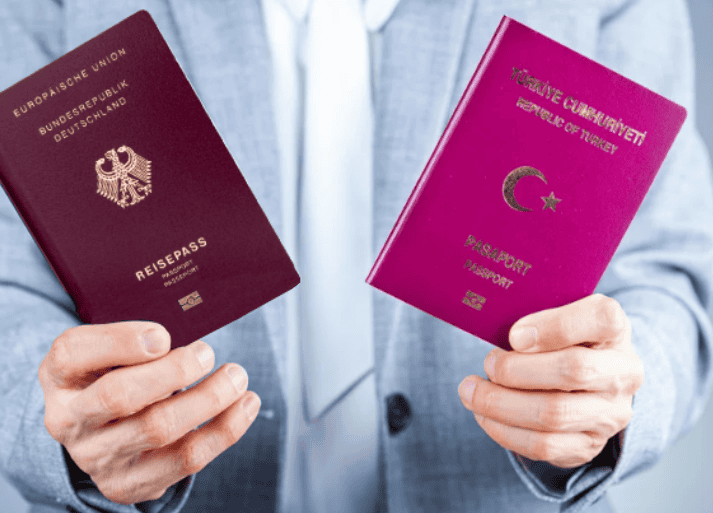
However, if dual citizenship is possible, one receives two passports, which is why the term “dual passport” is often used.
Naturalization figures
The number of naturalizations in Germany has been rising for years. While there were still around 107,000 naturalizations per year in 2015, the number has been rising steadily (with the exception of 2020, the year of the COVID-19 pandemic). In 2022, approximately 169,000 naturalizations were recorded, and in 2023, the figure had already reached nearly 201,000. In 2022, there were approximately 14,300 naturalizations of individuals originally from Turkey. In 2023, approximately 10,700 people with Turkish citizenship were naturalized in Germany. Of these approximately 10,700 Turkish citizens, about 87% lost their Turkish citizenship, while 13% retained both citizenships.
This trend is not expected to continue in 2024, as the Citizenship Modernization Act (StARModG), which took effect in mid-2024, allows German citizens to acquire dual citizenship without losing their existing citizenship. Since then, it has no longer been necessary to renounce one’s previous Turkish citizenship.
What role does dual citizenship play?
Dual citizenship plays a particularly significant role for people of Turkish descent in Germany. For many, citizenship is not merely a legal formality, but a deeply rooted aspect of their identity. People with an immigrant background, in particular, find it liberating not to have to choose between two countries.
The ability to be both German and Turkish strengthens one’s sense of belonging to both cultures and societies. For many, dual citizenship is also an expression of their personal history: For example, they may have come to Germany as guest workers, been born or raised in Germany, but still have close family or cultural ties to Turkey. This legal option allows them to acknowledge their identity without having to give up their original roots.
Obligations and Practical Benefits of Dual Citizenship
In addition to the emotional aspect, there are also very practical advantages. Many dual citizens have family, real estate, or business interests in Turkey. Dual citizenship makes it easier for them to travel, work, or own property in both countries without encountering complicated visa procedures or legal restrictions. They can fully benefit from the rights and obligations of both countries—whether it involves inheritance laws, social benefits, or pension entitlements. Especially during times of international crisis, this can be an important safety net, as they can rely on the protection of both nations.
However, dual citizenship also entails certain obligations, particularly with regard to taxes. In some cases, this can lead to double taxation, for example, if income is earned in both Germany and Turkey. In such cases, however, bilateral tax treaties often apply to prevent double taxation. Nevertheless, it is advisable to familiarize yourself with the relevant tax regulations early on to avoid financial disadvantages.
Safety during your stay
Overall, dual citizenship is a great relief for many people. It allows them to achieve legal certainty in their country of immigration without having to give up their ties to their country of origin. It protects against discrimination, facilitates political and social participation, and helps ensure that people with a migration background in Germany no longer feel compelled to give up part of their identity. Despite some legal obligations, the advantages outweigh the disadvantages for most people—after all, dual citizenship means not only two passports, but also the freedom not to have to choose between two worlds.
Can Turkish citizens obtain dual citizenship?
When acquiring German citizenship in addition to another nationality, such as Turkish citizenship, it does not matter which country you came to Germany from. The only determining factor is whether the legal requirements for naturalization under Section 10 of the Nationality Act (StAG) are met.
Regulation in effect through 2024 – Prevention of dual citizenship
The legal framework underwent a fundamental change in early 2024. Whereas the principle prior to 2024 was that multiple citizenship should be avoided—meaning that individuals should hold only one nationality—this principle was abandoned in mid-2024. This means that, up until that point, those seeking naturalization generally had to renounce their previous citizenship in order to become German citizens. This posed a significant hurdle, particularly for Turkish nationals in Germany, as many did not wish to sever their legal and cultural ties to Turkey.
Regulations effective in 2024 – dual citizenship generally permitted
The 2024 reform of the nationality law introduced significant changes that make it easier to acquire German citizenship and generally allow for dual citizenship. Those who acquire German citizenship no longer have to renounce their previous citizenship. This means that Turkish citizens can now become German citizens without losing their Turkish citizenship or their connection to their cultural roots.
Do you have any questions about dual citizenship in Turkey?
Feel free to call us at 069 87006620 or fill out our contact form.
What requirements must you meet to become a German citizen?
The 2024 reform of the Nationality Act introduced significant changes that make it easier to acquire German citizenship and generally permit dual citizenship. To acquire German citizenship, the following requirements must be met in accordance with Section 10(1) of the Nationality Act (StAG):
Legal capacity, application, and verified identity: Naturalization under § 10(1) of the German Nationality Act (StAG) requires an application from a person with legal capacity. A person is legally competent if they have reached the age of 16, provided they are not legally incapacitated. In such cases, only the legal representative is authorized to file an application on behalf of minors or legally incapacitated persons. The applicant’s nationality and identity must be declared and known.
Legal and habitual residence in Germany: Anyone wishing to acquire German citizenship must have been legally residing in Germany for at least five years (prior to the reform: eight years). This minimum period of residence must have been met at the time the application is filed. In addition, the person must hold an unlimited residence permit or a settlement permit. The residence must therefore be lawful. Residence without a permit is sufficient. A waiver of measures terminating residence is not sufficient; thus, for example, naturalization is not possible with a temporary stay permit or a provisional residence permit.
Proof of sufficient means of support: The applicant must be able to support themselves and their dependents without government assistance. The applicant must not be receiving long-term social assistance or basic income support (formerly Hartz IV). The exception allowing naturalization despite financial hardship through no fault of one’s own (e.g., illness, studies, parental leave) now applies only to naturalization applications submitted by August 23, 2023. In this respect, the amendment to Section 10 of the Naturalization Act (StAG) in mid-2024 has led to a deterioration in the situation.
However, an exception applies if the applicant has been employed for 20 months during the 24 months preceding the filing of the naturalization application. In this case, this also applies to minor children as well as to the applicant’s spouse or partner who has been employed for at least 20 months during the preceding 24 months.
No criminal record or serious offenses: The applicant must not have committed any serious offenses, and there must be no ongoing criminal investigations against them. However, all criminal convictions, summary judgments, orders for corrective and preventive measures (in cases where the applicant is not criminally responsible), and juvenile sentences are taken into account. Minor offenses (e.g., fines of less than 90 daily rates) are generally not an issue.
Proof of German language proficiency: Applicants must demonstrate German language proficiency at the B1 level of the Common European Framework of Reference for Languages (CEFR). Proof can be provided, for example, by a language certificate (e.g., from the Goethe-Institut, telc, or an adult education center) or a high school diploma from Germany.
Passing the naturalization test: Applicants for naturalization must pass the naturalization test. The test consists of 33 questions on German history, culture, and the legal system. Anyone who has attended a German school and holds a school-leaving certificate is exempt from this test.
Commitment to the free democratic basic order, as well as to Germany’s special historical responsibility for the Nazi regime of injustice and for the protection of Jewish life: Anyone seeking to acquire German citizenship must commit, on the one hand, to the free democratic basic order—the Basic Law—and, on the other hand, to the protection of Jewish life. A declaration of loyalty must be submitted regarding both of these issues. The applicant must not only submit the declaration but also demonstrate knowledge of the free democratic basic order and the historical background of the Nazi regime’s injustices and their consequences.
Merely paying lip service to the content without understanding it or being aware of it is not sufficient in cases of doubt. The authorities may order a personal interview to verify whether the applicant possesses the required knowledge of civics. Simply passing a naturalization test and participating in an integration course is not sufficient, as these do not equate to the required basic knowledge of civics.
Applicants for naturalization are therefore required to have a broad and in-depth basic understanding of the subject matter so that they can, for example, demonstrate their commitment to the Basic Law, its principles, and fundamental rights.
Renouncing or relinquishing one’s previous nationality, or being released from one’s previous nationality (Section 10(1)(4) of the previous version of the Nationality Act), is expressly no longer required.
What benefits are available to former Turkish guest workers?
For former Turkish guest workers, there are two key concessions regarding language proficiency and the ability to support themselves. Anyone who came to Germany (dated October 30, 1961) before June 30, 1974, are not required to prove that they can support themselves without benefits such as social assistance (SGB XII) or basic income support (SGB II).
Even if you are receiving social assistance or a basic income in such a case, you can become a German citizen as a former guest worker (Section 10(1), sentence 1, no. 3a of the German Nationality Act). The same applies to guest workers who came to Germany before June 30, 1974, under other recruitment agreements with the Federal Republic of Germany (e.g., Italy, the former Yugoslavia, Greece, Spain, etc.).
Relief regarding language skills
The requirement for sufficient German language proficiency (Level B1) may be waived for former guest workers if they are able to communicate orally in German in daily life without significant difficulty (Section 10(4), sentence 3, StAG). This means being able to communicate in German in a simple manner. The exemptions regarding language proficiency have been in effect since mid-2024 and were newly introduced by the Citizenship Modernization Act (StARModG).
Do you have any questions about dual citizenship in Turkey?
Feel free to call us at 069 87006620 or fill out our contact form.
Conclusion
- Definition of dual citizenship: Dual citizenship means that a person holds the citizenship of two countries at the same time. In some countries, this is possible without any issues, while in others, the person must renounce their previous citizenship. Whether a person can retain both citizenships depends on the relevant legal regulations.
- Significance for Turkish nationals in Germany: For many people of Turkish origin in Germany, dual citizenship is of great legal and identity-forming importance. It allows them to preserve their cultural and family roots in Turkey while also enjoying the benefits of German citizenship.
- Historical Naturalization Regulations and Changes in 2024: Until mid-2024, Germany adhered to the principle of avoiding multiple citizenship, meaning that most applicants for naturalization had to renounce their original nationality. With the reform of the nationality law, this requirement was abolished, meaning that Turkish nationals can now acquire German citizenship without having to renounce their Turkish citizenship.
- Practical benefits of dual citizenship: Dual citizens enjoy numerous benefits, such as greater freedom of travel between the two countries, property rights, inheritance rights, social benefits, and pension entitlements in both countries. They are also entitled to consular protection from both countries.
- Obligations and potential challenges: In addition to the benefits, there are also obligations, such as potential tax implications resulting from income earned in both countries. Furthermore, male Turkish citizens may still be subject to mandatory military service.
- Simplified naturalization procedures for former Turkish guest workers: Turkish guest workers who came to Germany before 1974 are eligible for special simplified naturalization procedures. For example, they are not required to provide proof of formal language proficiency as long as they can communicate in German in everyday life. In addition, they are largely exempt from the requirement to independently secure their livelihood.